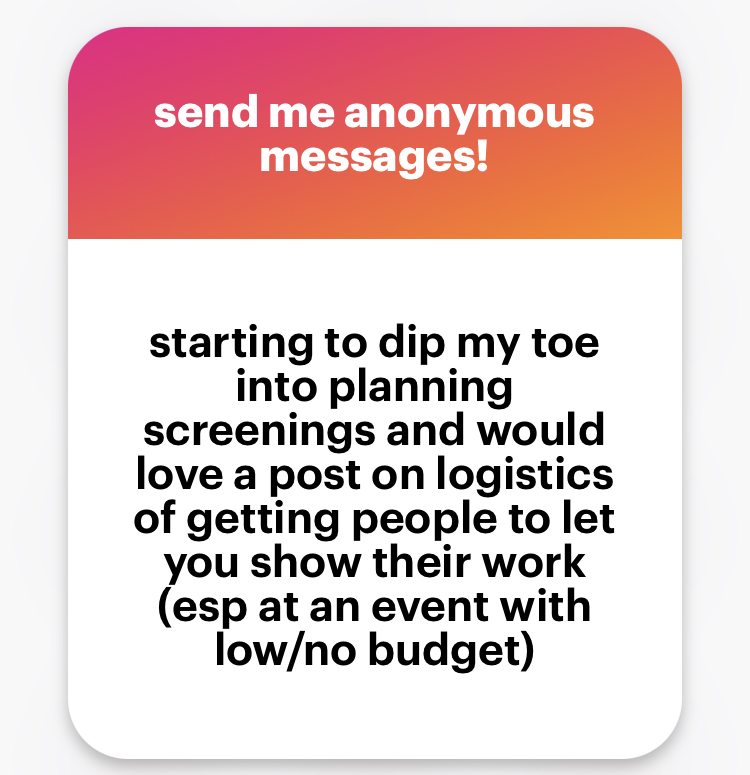
Someone sent me the following blog post request and I thought it was an excellent prompt! Huge disclaimer that I have only been doing this seriously for about a year and am by no means an expert. This is all stuff I’ve figured out myself or picked up from various jobs and roles in the film industry, but is not necessarily coming from a place of “official” guidance. This is just what works for me and I hope it helps other people too!
I’m going to keep this focused on short films because that’s what I have the most experience with and I think a lot of the advice I’m giving here is very specific to shorts for various reasons. As I discussed in my last post, short films are not really monetizable in the US, are mostly made for exposure, and do not usually have a lot of options for a life beyond festivals and the vast expanse of Vimeo. They are also less likely than features to be represented by a distribution company, though there are a good number of exceptions. So if you want to program short films that don’t have distribution and negotiate directly with artists, you are not going to have a lot of competition. In my experience, people are really honored to be asked and typically pretty excited for their movie to be shown regardless of your ability to pay them. There are a few asterisks and parameters about this which I will get into below, but the short answer is you should just reach out to people and ask because they’ll probably say yes. I’ve programmed around 30 short films directly from artists since I started doing this last year and I have never had someone turn me down.
Considerations when selecting films:
Obviously the first step is to decide what you’re going to put in your program. There’s a lot I could say about the creative elements of curation, but I’ll save that for a future blog post. If you want to save yourself a bunch of time energy by only reaching out to people who are likely to say yes, make sure to take these questions into account:
- Do they have distribution? Some films are represented by a distribution company or educational institution, which will charge you a set screening fee. The artist does not have a say in this and will not be contacted in the process of licensing the movie. If you’re doing a low or no budget screening I would just consider these to be off the table entirely and not bother with them.*
- Where are they in their festival run? The main reason I can think of that someone without distribution would not want their film to play in your screening would be that they are in the middle of their festival run and might have externally imposed limitations on where they can screen. A lot of film festivals require non-compete clauses and do not want the films they screen to play in the same city within a 6 month period. In reality, this is quite hard to enforce and it’s not really as important for short films, but a lot of filmmakers do take this seriously. So while it’s definitely worth reaching out to people in the middle of their festival run, be prepared for some of them to say no if they’re within a year of their film being released.
*this is assuming you don’t want to do unlicensed or illegal screenings, which I am not unilaterally opposed to. I could write a lot about this nuanced topic but I won’t (for now) because the question was about doing stuff specifically with artist permission.
Sourcing films:
Okay, okay but where do you actually FIND the films?
- Personal network/social media. This is where I always start. Everything I’ve curated has been built around a film that I was personally involved with and wanted to showcase alongside compatible films. I also have a lot of fellow creatives in my networks whose work I try to keep abreast of. Finally, I also know a few fellow film programmers who I will sometimes ask for recommendations when I have a really specific idea of what I’m looking for (I don’t wanna ask them to do a bunch of work for me, but I will ask them if I can say something like “I’m looking for a short film about XYZ topic, know anything off top?”)
- Film festival archives. If you go to the websites of film festivals, they will usually have archives of what was in their previous festivals. This is a great way to find out about movies. By looking at the archives of previous years as opposed to the current year, you can guarantee that you will be looking at films that have already completed their festival run. You can also of course check out current offerings, but just know they’re less of a shoe-in.
- Letterboxd. I’ve used Letterboxd to find films in various ways. One way is that I just kinda troll around there a lot and have accidentally stumbled upon cool artists I ended up programming. I have also used it in a more intentional way by looking up lists of movies about certain topics and sorting them by length to find all the shorts.
- Open submissions. I’d be remiss to not discuss this option, even though I personally don’t tend to do this. The vast majority of things that get programmed (at festivals or otherwise) are things that get solicited from artists, not from open submissions. I have been a screener for a large film festival, and it’s a shitton of work to sort through a bunch of submissions that are usually not very good. As a small independent programmer doing open submissions, though, you’re likely to have the opposite problem. You’re probably not gonna get that many submissions because you’re not necessarily on people’s radars (the ones you do get will probably still be mostly bad though). It takes a lot of work and outreach to promote a call for open submissions and I figure it’s a better use of my limited time to search for things to directly solicit using the methods mentioned above . I’m absolutely missing out on hidden gems by not doing open submissions, but it’s never been worth it to me in the larger calculus of maximizing my limited time and resources. Also, I keep my DMs open year-round with a note in my bio for people to send me their screeners. This happens extremely infrequently, reinforcing my belief that open calls are not very useful.
Tracking down the artists:
If you’re finding things from festival websites or Letterboxd, there’s going to be an extra step where you need to actually find the contact information of the artists. This is usually fairly simple since most people have social media and/or professional websites with their email address listed. I usually just Google the person’s name or person’s name + filmmaker. Sometimes it takes a few tries of different keyword searches but it works like 90% of the time. If you really can’t find someone that way, you can reach out to someone who works at a film festival or venue where their work screened in the past and ask to be put in touch.
Reaching out to filmmakers:
So you’ve decided on a film or films you want to invite to your screening and tracked down the creator’s contact info. What are the best ways to communicate with the artist? I try to send clear and informative emails with as much transparency as possible.
The first question to ask yourself is whether you’re going to be sending a screener request or a hard invitation. If the film isn’t available online or you haven’t seen it before, you should probably start with a screener request just to make sure the short is right for your program. Don’t be afraid to reach out and ask, this is super normal and programmers do it all the time. Screening the film puts you under no obligation to include it in your program and you should not worry about hurting the filmmaker’s feelings if you don’t end up screening it – they are probably used to it. The one thing to consider is that if you’re not connected to a festival or a venue, you should just be as professional as possible and explain who you are so that the filmmaker trusts you with their private screening file.
Once you’ve decided you want to include something in your program, it’s time to send out formal invitations. I always try and include the following:
- What is your event and who are you? I think it’s good to assure artists that you’re thoughtful and respectful. A big part of this is clearly communicating what your event is, what your intention behind the curation is, and a general idea of who will be participating and watching the films. This is especially important if the event is not going to be paid. I think a lot of independent artists are happy to have their work shared for free at community events, they just want to be assured that you’re not making money off their work without paying them and that it’s going to be appreciated by the audience you bring.
- What can you offer them? This does not have to be financial. New eyes on their film, a chance to make a community impact with their work, or photos of a bunch of people watching their film at an event are all non-monetary things that independent artists value. If you are offering money, make this clear up front.
- Know what assets you need from them. I like to ask for everything I’ll need up front so I’m not going back and forth a million times asking for stuff. Usually this is the screener file (with any technical specifications laid out) and a few stills for promo. As an artist, I’ve also been asked for a video Q&A, a couple sentences about why I made my film, and a trailer. Also if you need any captions or subtitles for accessibility this is the time to ask!
If some event details are unconfirmed, that’s okay! Just explain to the artists what those elements are and keep them updated as you solidify details. I have reached out to people saying something along the lines of “I don’t know how, but this will be paid” and had the artist go along with it.
A note on screening fees:
If you are able to offer screening fees, that’s obviously great! Bros Before has been screened in the US, Canada, and Europe with screening fees ranging from $25-$150. These are usually pretty all over the place, random, and dependent on the budget of the festivals. So it’s pretty unlikely that filmmakers without distribution are going to set a hard rate for a screening fee.
Another option is to give filmmakers a percentage of the box office or door fee. This is my preference when possible because it just kinda feels the most equitable. Also, it has the added bonus of not requiring any overhead.
Post-Mortem:
The last part of this is wrapping up communications with artists after the event. This is really important because you want people to feel taken care of and be willing to work with you again in the future! If there’s anything you promised to the filmmakers (such as payments or event photos) make sure to take care of it within a month at the latest. It’s also great to give a brief description of the event and the audience reactions for those who weren’t able to be there in person.
Thanks for reading and thanks to the anonymous person who asked that great question! If you want to ask me anything else feel free to submit an anonymous question!
 DEGENERACY NOW!
Leave a comment